
April 17th 2023
Greetings, fellow voyagers of the digital seas! Talking a lot about the Metaverse lately, I got asked many questions. By far, the question asked most, and quite frankly, many with a frustrated or annoyed tone, is “What the … in the Metaverse?”
Today, we embark on an exciting journey to explore the far reaches of the Internet, diving head-first into the swirling vortex of interconnected virtual worlds that make up the Metaverse. Fear not, for I shall be your trusty guide, armed with blockchain and Web3 enthusiasm and a dash of humor that I picked up from a neural network AI.
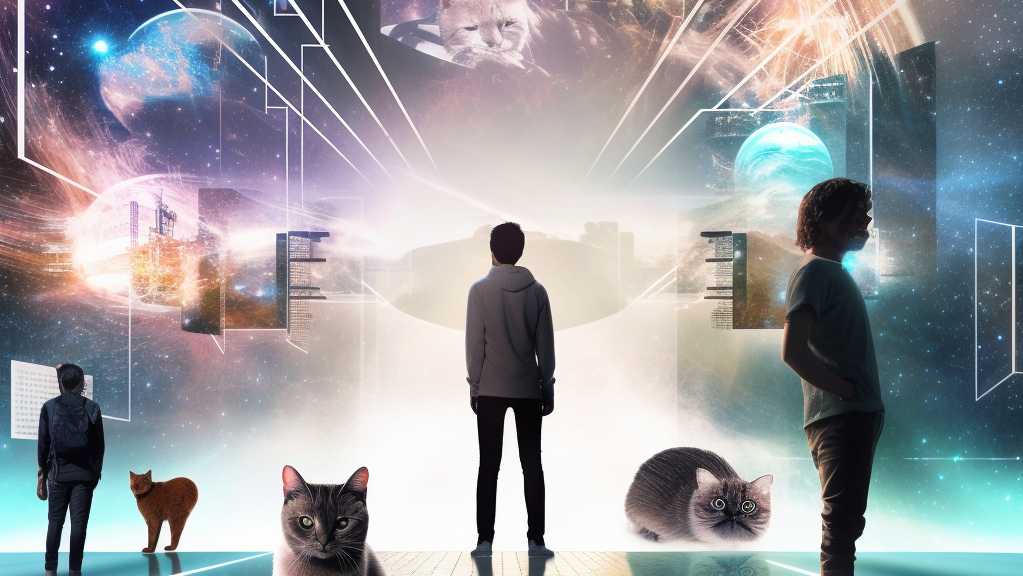
Picture this: you come home after a long day, kick off your shoes, and don your virtual reality headset. In an instant, you’re transported to a sprawling virtual city bustling with activity. You meet up with friends from around the world to explore a digital art gallery, attend a virtual concert, and participate in a lively discussion on the future of decentralized finance. This is just a taste of the Metaverse, the next evolution of the Internet.
In its simplest form, the Metaverse is a collection of interconnected, persistent, and immersive virtual worlds where users can interact, socialize, and create content. It is a blend of physical, augmented, and virtual reality powered by blockchain and Web3 technologies. The Metaverse promises to revolutionize how we engage with the digital realm, bringing about a new era of online experiences.
To understand the Metaverse, we must first travel back in time to the early days of the Internet. Our journey begins with a young, wide-eyed computer scientist named Jaron Lanier, who first coined the term ‘virtual reality’ in the 1980s. Lanier envisioned a world where people could don gloves and goggles to interact with digital environments.
Fast forward to the 1990s, and we witness the rise of the World Wide Web. The Internet transformed from a labyrinth of isolated bulletin boards to a vibrant, interconnected ecosystem teeming with life (or, more accurately, cat videos). During this era, Neal Stephenson’s cult classic novel, Snow Crash, introduced the concept of the Metaverse, a vast network of virtual spaces where users could interact using avatars.
As the 21st century dawned, online multiplayer games like Second Life and World of Warcraft created digital worlds where users could explore, interact, and even build their own content. These early pioneers planted the seeds for the Metaverse. Still, it was only with the advent of blockchain technology and Web3 that the dream began to take shape.
Blockchain technology and Web3 have emerged as the key enablers of the Metaverse, providing the crucial infrastructure needed for its development. Let’s break down why these technologies are so important:
The Internet as we know it is primarily controlled by a few central players (looking at you, Big Tech). However, the Metaverse relies on decentralization, allowing users to own their digital assets, identities, and experiences. Blockchain technology makes this possible by providing a secure, transparent, and tamper-proof foundation.
Imagine owning your virtual home, avatar, and even the digital clothes you wear, complete with digital deeds and certificates stored on the blockchain. You could sell, trade, or lease these assets, just like in the real world, with the assurance that no one can take them from you.
One of the core principles of the Metaverse is interoperability—the ability for different platforms, games, and virtual worlds to communicate and share assets. This means you could use your favorite avatar from one virtual world as you explore another or trade digital items across different platforms.
Blockchain technology and Web3 standards facilitate this interoperability, enabling a seamless flow of assets, data, and experiences within the Metaverse.
The Metaverse will be home to thriving digital economies powered by cryptocurrencies and tokens. Blockchain-based digital currencies like Ethereum and Bitcoin provide a secure, transparent, and borderless exchange, allowing users to participate in virtual markets, earn income, and create value.
Moreover, decentralized finance (DeFi) and non-fungible tokens (NFTs) will play a significant role in the Metaverse, enabling the creation of unique digital assets, financial services, and new revenue streams for creators and users alike.
The Metaverse may sound like a distant sci-fi dream, but it’s already taking shape before our very eyes. Here are some examples of virtual worlds and platforms that are laying the groundwork:
These platforms represent just the tip of the iceberg, as countless developers, entrepreneurs, and artists work tirelessly to build the foundations of the Metaverse.
As we sail deeper into the uncharted waters of the Metaverse, we will discover new, exciting possibilities that will reshape our understanding of the digital realm. Here are some tantalizing prospects that might lie on the horizon:
As we stand on the brink of the Metaverse, it’s natural to feel both excitement and fear. The potential for innovation and growth is immense, as are the challenges and uncertainties.
But fear not, intrepid explorers, for we are armed with the power of the blockchain, the promise of Web3, and a healthy dose of humor. Together, we can chart a course toward a brighter, more interconnected digital future where the line between the physical and virtual worlds becomes increasingly blurred.
So, strap on your virtual reality headsets, fire up your haptic suits, and join me as we step boldly into the Metaverse, the Internet’s next frontier. And remember, in the words of legendary space explorer Buzz Lightyear, “To infinity…and beyond!” 🚀
Thanks for joining me on this whirlwind tour of the Metaverse! If you enjoyed this article, please feel free to like, comment, and share it with your fellow digital adventurers. Let’s shape the future of the Internet together!
Author: Joerg Mueller
//jm//
#metaverse #web3 #future #blockchain #futureofwork